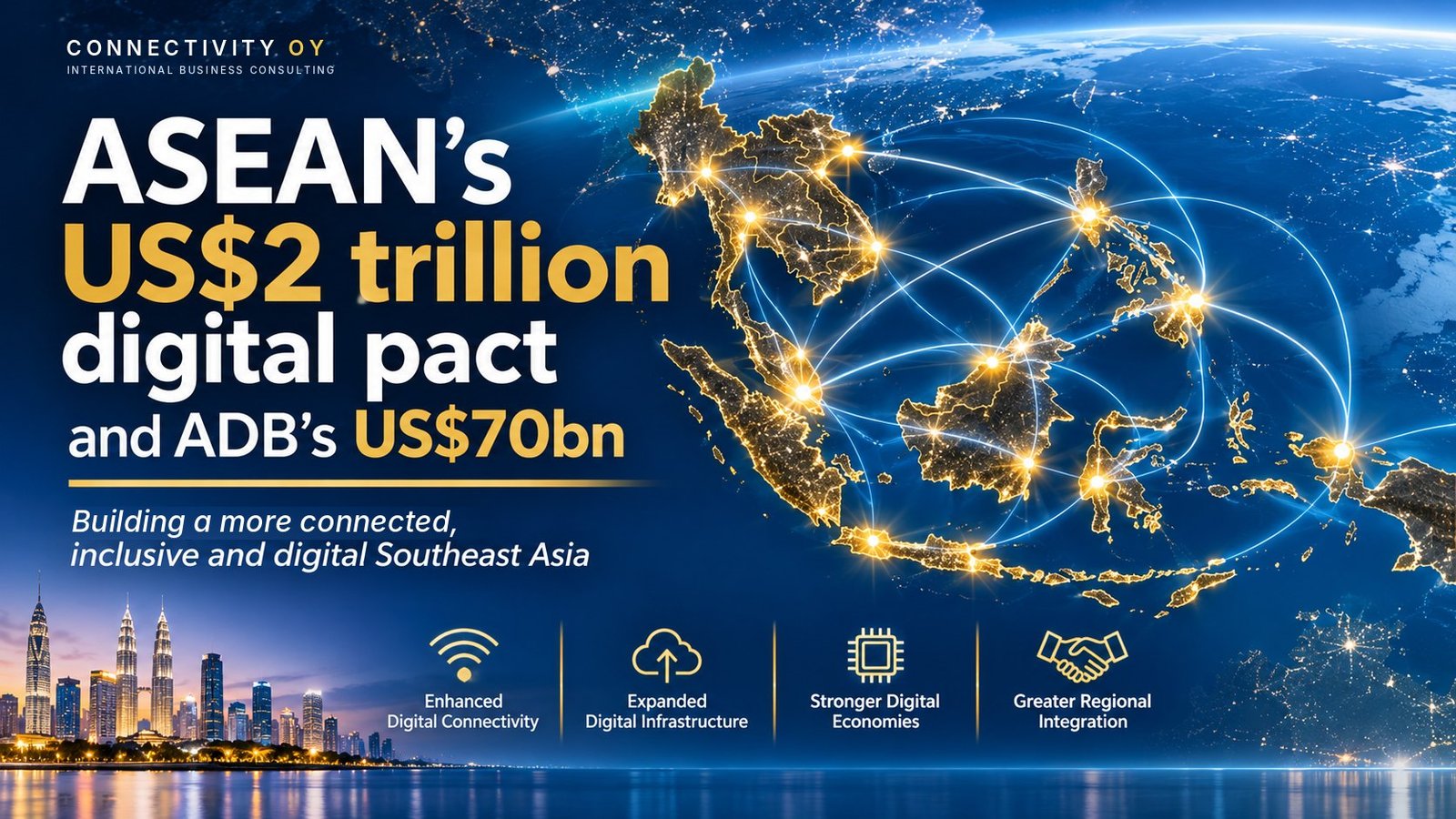
ASEAN's first region-wide digital economy agreement is due for signature in November 2026, and ADB has pledged US$70 billion for power grids and digital networks by 2035. Here is what it means for technology suppliers.
Southeast Asia is moving from national digital strategies to a single regional market. Two decisions in 2026 set the direction: a binding digital trade framework among ASEAN members and a major financing commitment for the cables, grids and data centres that will carry it.
ASEAN’s Digital Economy Framework Agreement (DEFA)
ASEAN concluded negotiations on DEFA, its first region-wide digital economy agreement, on 30 May 2026 at the Senior Economic Officials Meeting in Manila. Signing is targeted for November 2026, alongside the 49th ASEAN Summit (Manila Bulletin, 31 May 2026).
DEFA covers:
- Digital trade and cross-border e-commerce
- Data governance, privacy and digital identity
- Electronic payments and online safety
- Cybersecurity cooperation and competition policy
- Emerging technologies, including AI, and digital talent mobility
ASEAN expects the agreement to double the region’s digital economy to US$2 trillion by 2030, compared with about US$1 trillion without it (Manila Bulletin, 31 May 2026).
ADB’s US$70 billion commitment
On 3 May 2026, the Asian Development Bank announced US$70 billion by 2035 for two programmes (ADB, 3 May 2026):
- Pan-Asia Power Grid Initiative — US$50 billion: cross-border transmission, substations, storage, grid digitalisation and renewable export hubs, including the ASEAN Power Grid. Targets include about 20 GW of renewables integrated across borders and 22,000 circuit-km of transmission lines.
- Asia-Pacific Digital Highway — US$20 billion: terrestrial and submarine fibre, satellite links, digital corridors, regional data centres and cybersecurity support, with targets including first-time broadband for 200 million people and connectivity costs about 40% lower in remote areas.
ADB expects to finance about half of the power programme from its own resources, and US$15 billion of the digital programme, with the rest from co-financing.
What this means for the six key markets
For Malaysia, Indonesia, Singapore, the Philippines, Vietnam and Thailand, the combination creates demand in:
- Data infrastructure: data centres, energy-efficient cooling, edge computing
- Connectivity: fibre backbones, submarine cable landings, network security
- Trust services: digital identity, e-signatures, data protection compliance
- Payments and fintech: cross-border payment links, fraud prevention, regulatory technology
- Energy for digital: grid upgrades and renewables to power data-centre growth
Much of this will be procured by governments, state utilities and ADB-financed programmes — through tenders with strict qualification, partnering and local-presence requirements.
What Connectivity is monitoring
- DEFA signature in November 2026 and national implementation timelines
- ADB project pipelines under the Digital Highway and Pan-Asia Power Grid
- Data-centre and fibre tenders in the six markets
- Data-localisation and licensing rules that affect foreign suppliers
Enter Southeast Asia’s digital build-out with the right partners. Connectivity tracks ADB pipelines, national tenders and regulatory changes across the region, and connects you with vetted local partners.